“Cow manure” is not one material. Two bags carrying the same two words can do opposite things to your soil, and the bag is usually the last place you find that out.
Cow manure is a category, not a recipe. What the animal ate, how long the manure was left, and whether it was composted or only dried all change what ends up in your pot. Composting is the part that brings the salts down and finishes off the weed seed, and time is what does the composting — the one input nobody has ever managed to shortcut.
So those two words on the front are where the question starts, not where it ends. The useful thing to ask of any bag, ours included, is what was actually done to it and how long that took. The rest of this page is our answer.
02
What we actually use
Composted for at least 90 days — not dried.
Composting is the part of the process that generates heat and finishes the breakdown. Done before the bag is filled, it finishes in the pile. Skipped, it finishes in your pot, against your roots.
Prahas Cow Manure is composted for a minimum of 90 days under controlled conditions: fully matured, ammonia-free, and biologically active. That is what the word “aged” is doing, and it is the reason it feeds steadily rather than quickly.
03
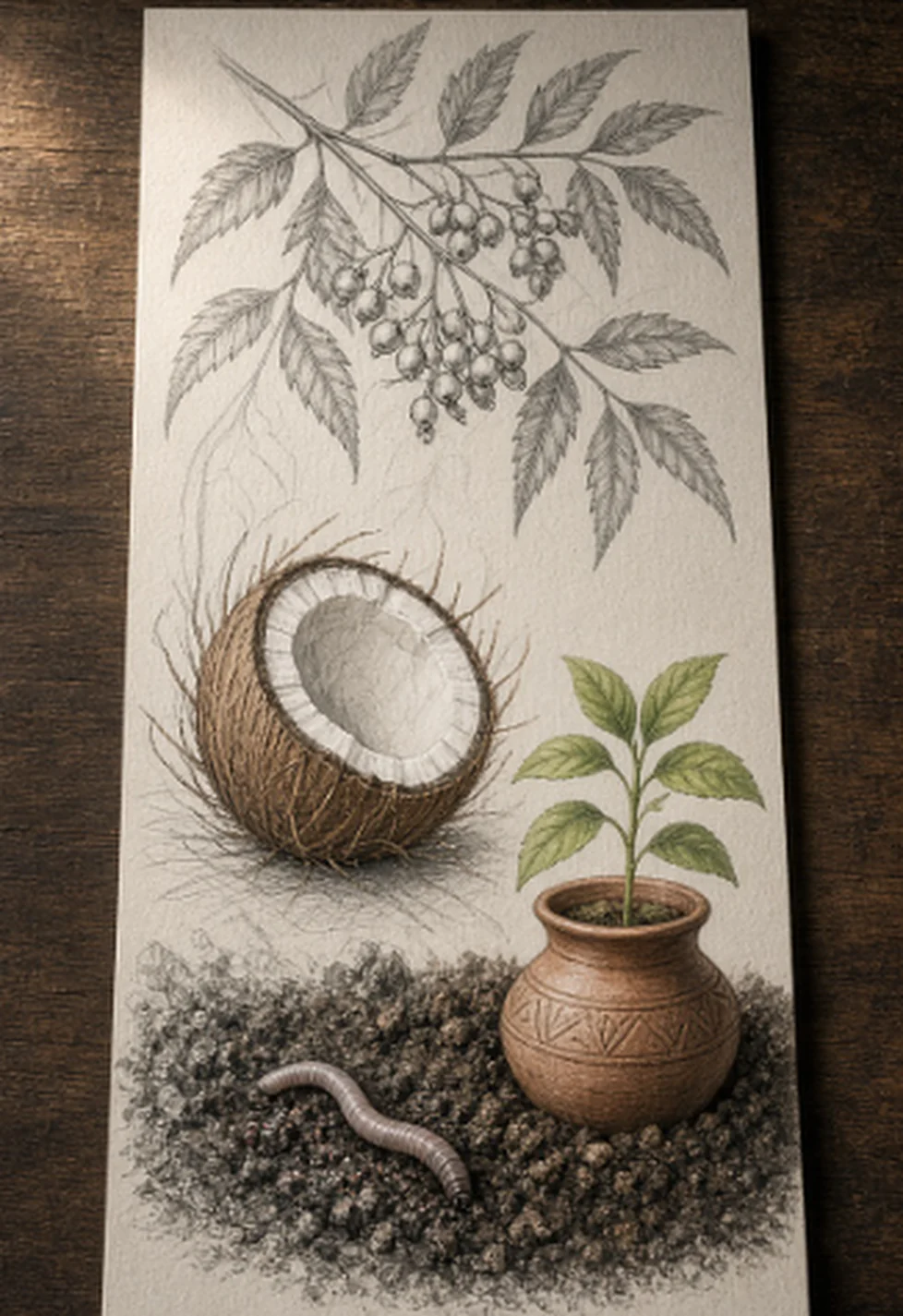
Earthworms, coconut husk, the neem tree
Each input is named for what made it.
The question is the same one, asked three times. For vermicompost: was it finished, or bagged while the worms were still working? For cocopeat: was the husk salt washed out, or passed on to your roots? For neem: was the seed pressed cold, or heated because heat is cheaper?
These are what we ask our suppliers, and worth asking of any bag, including ours. None of the three is new; what differs is what was done to them. Anything that cannot be said in plain language does not go on the packet. Nothing synthetic. Ever.
04
Made for growing here
Inputs for this climate, not translated from another one.
A balcony in north India in June is not a greenhouse in a temperate country, and a potting mix built for one is not built for the other. Monsoon rain leaches a pot in a way a watering can never does. Heat drives off what is sitting on the surface.
Prahas inputs are made in India, for soil and seasons here, and the dosage guidance assumes the conditions you are actually growing in.
Fully matured, ammonia-free, and biologically active. What you receive is not raw manure.
Prahas Cow Manure · the product record
Why Prahas · one of three longer answers
The specifics are on the product pages, not in the adjectives.
What each input is made from, how much to use, and for what size pot — in grams and in days, on that product’s own page. If something you want to know is not there, write and ask. We will tell you, or we will say we do not know, which is the honest half of the same answer.